
System performance comparison
A direct cost comparison between conventional UV-C lamps and UV-C LEDs is challenging. In practice, these technologies are generally not interchangeable on a one-to-one basis. Replacing UV lamps with LEDs would typically require a substantial redesign or retrofit of the complete UV system, including its optical, electrical and thermal design. For an objective comparison, a full lifecycle analysis at system and application level would therefore be more appropriate. However, to provide an indication of the differences in replacement costs, this article uses a simplified scenario in which UV lamps and UV-C LEDs are assumed to be interchangeable UV-C sources.
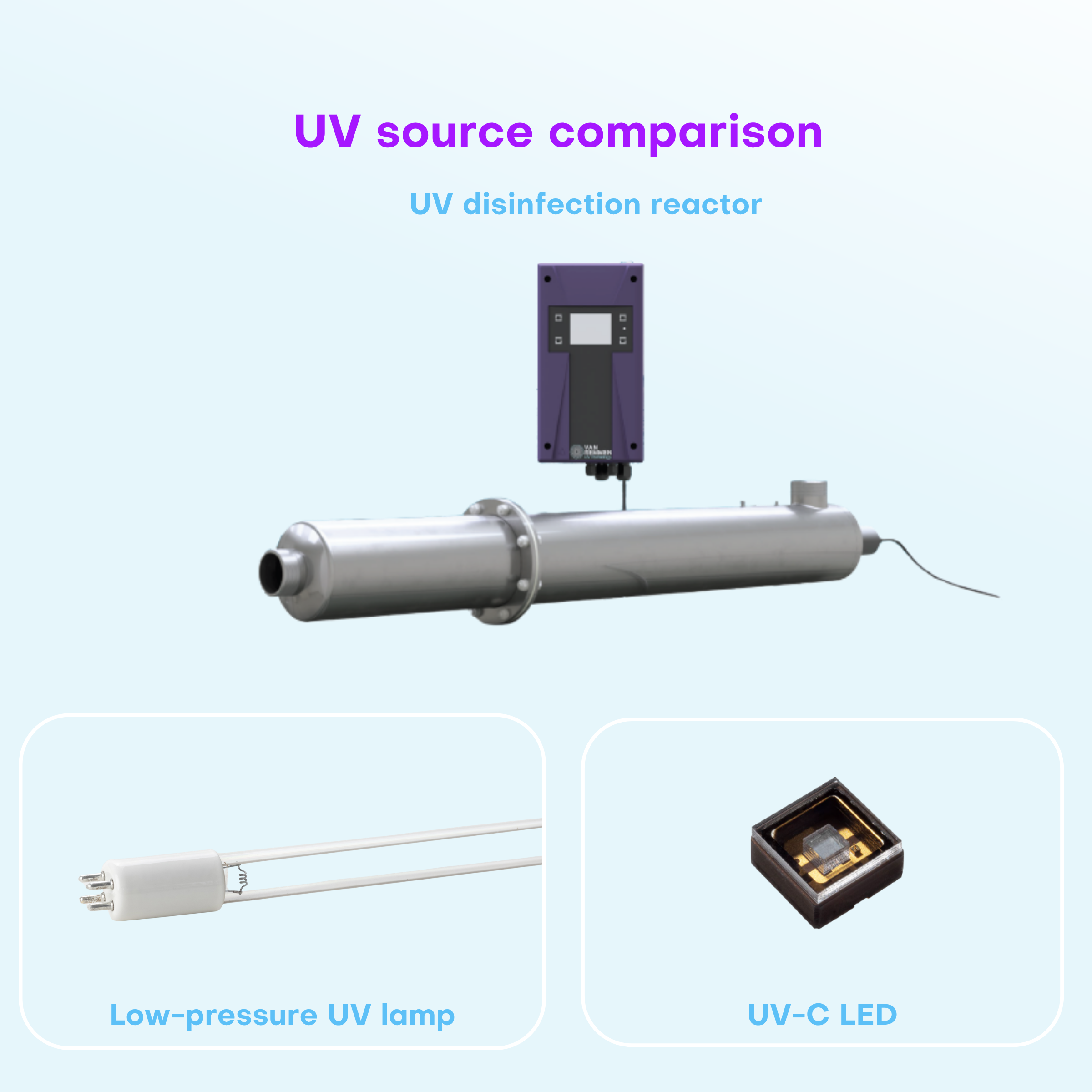
Comparing performance of UV sources
This represents an idealised scenario in which both technologies are assumed to be fully interchangeable, with LEDs positioned like a conventional lamp, surrounded by water, passively cooled, and providing optimal UV-C light distribution. In practice, however, the optimal design principles for low-pressure lamp systems and LED-based systems differ substantially. Low-pressure lamps and UV-C LEDs require fundamentally different reactor designs, and achieving uniform dose distribution with a large number of individual LED sources introduces additional optical, thermal and electrical design challenges.
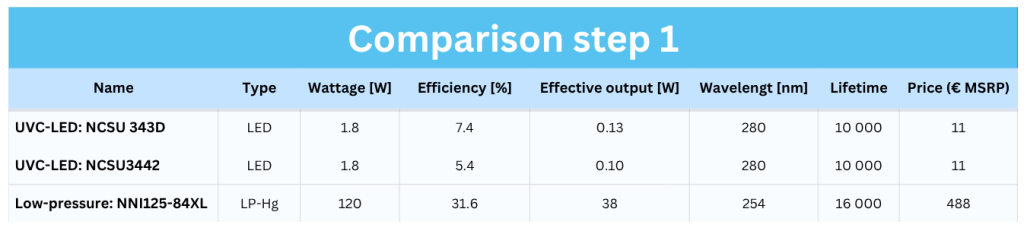
Replacing UV low-pressure lamps by UV-C LED
This study presents a direct engineering comparison in which a single low-pressure UV-C lamp in the V160 system is fully replaced by UV-C LEDs. As an illustrative case, the comparison focuses solely on quantitative metrics, deliberately excluding operational considerations such as availability, form factor, overall system efficiency, and wavelength differences.
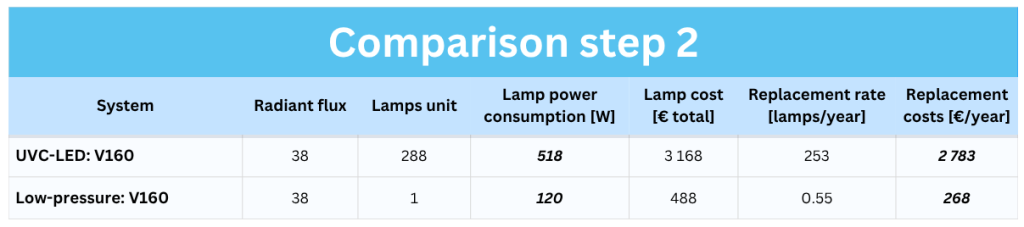
Replacement costs
As can be seen directly replacing a low-pressure lamp for a state-of-the-art UVC-LED will result in:
- A lamp purchase cost increase of 649%
- A more than 10 times lamp replacement cost increase
- A power consumption increase of 432%
The increase in energy costs is caused by the difference in wall-plug efficiency of UVC-LEDs: 2-8% compared to 30-40% for low-pressure lamps. Energy efficiency is one of the most important parameters when comparing UV-C technologies. However, a meaningful comparison cannot be based on a single parameter, such as UV source.
Reactor design and application matter
Reactor design has a significant impact on the overall energy performance of a UV system. The positioning of the UV sources, hydraulics, UV transmittance, optical losses and dose distribution all determine how effectively the generated UV-C light is used. A well-designed reactor can therefore reduce the amount of UV-C output required to achieve the target dose.
The application and operating profile are equally important. UV-C LEDs can be switched on and off instantly, which can reduce energy consumption in intermittent, low-duty-cycle applications. But this advantage becomes much less relevant in applications where a continuous UV disinfection barrier is required. For this reason, energy performance should be compared at system and application level, under equivalent operating conditions, rather than on source efficiency alone.

UV-C water disinfection in horticulture
UV disinfection provides a reliable way to treat drain water before reuse by inactivating microorganisms such as bacteria, fungi and moulds. This allows growers to safely recirculate water without increasing the risk of disease transmission. At the same time, monitoring and controlled treatment of water flows help growers comply with increasingly strict regulations and the measurement and management of water streams.

UV Solution
A total of 32 UV reactors each equipped with 1 low-pressure 400W UV-C lamp, with a combined capacity of maximum of 25 m³/h, to realise a very high UV-C dose of 2500 J/m² to be effective against all pathogens.
UV Results
Bacteria, fungi and moulds are successfully eliminated
UValue Creation
Drain water treated: Enable recirculation of water
Environmental impact: Proper disinfection of water to meet strict environmental regulations.
The challenge: treating drain water from a strawberry grower
This strawberry grower in the central region of the country produces approximately 8 million kilograms of strawberries per year, across eight different varieties. The crops are grown in greenhouses, on racks, and in open fields, resulting in several types of drain water streams. Proper disinfection of this water is essential, particularly in light of increasingly strict environmental regulations.
Due to the coloration caused by the substrate and the addition of nutrients, the water—especially when coco peat is used—often has reduced transparency. This leads to lower UV transmittance, which requires a carefully designed approach to ensure effective UV disinfection.

Results after UV treatment
After installation of the UV disinfection system, water samples showed that bacteria, fungi, and moulds were reduced to safe levels, meeting the applicable regulatory requirements.

UV solution
A customized UV disinfection system was designed and installed for this application. The system has the capacity to serve a cultivation area of 16 hectares and disinfects drain water flows of up to 25 m³/h.
An advanced PLC with touchscreen interface automatically controls the flow and continuously calculates the UV transmittance (UVT) of the water. Sensors continuously monitor the water quality, after which the pump capacity can be automatically adjusted when required to increase the contact time. This ensures a more effective treatment and consistent disinfection performance.

Case study facts:
Location: The Netherlands
UV system supplier: VGE
Saving banana plantations through UV-C treated irrigation water
Contaminated irrigation water drives the spread of persistent pathogens like Fusarium TR4 and Ralstonia, posing a major risk to banana crops. UV-C disinfection offers an effective, chemical-free solution by inactivating these resistant microorganisms and preventing further disease spread.

Global threat for banana farming
Banana farming, especially of the popular Cavendish variety, is under serious threat from two major diseases: Fusarium Wilt (TR4) and Moko. Fusarium TR4 is a highly resilient fungus that spreads through contaminated soil, tools, and water, making it hard to remedy once it circulates in a plantation. Once a field is infected, the soil can remain contaminated for up to 30 years, making it nearly impossible to grow bananas there again. Vast areas are devastated, resulting in colossal damages. Moko disease, caused by the Ralstonia bacteria, is just as dangerous. It spreads rapidly through water, soil, and infected plants, leading to wilting and plant death. The problem is made worse because Cavendish bananas are all genetically the same, making them especially vulnerable. If these diseases aren’t controlled, they could severely reduce global banana production, affecting millions of people who rely on this crop.

UV Solution:
UV-C systems with multiple low-pressure lamps for capacities up to 540 m³/h/2500 GPM.
UV Results:
100% inactivation of TR4 and Moko at different banana plantations in South East Asia and Latin-America.
UValue Creation:
- Waste reduction: Eliminates the use of traditional chemical treatment with pesticides or chemicals.
- Water savings: Enables reuse of surface water, reducing the need to rely on costly and unsustainable water wells.
- Environmental impact: Allows farmers to irrigate their crops without the risk of spreading diseases.
Reuse of surface water
A typical 100-hectare banana plantation in Ecuador requires consistent irrigation, especially during the dry season from June to November. On average, each plant needs around 25 liters of water per day. With approximately 200,000 plants, daily water use reaches 5,000 cubic meters. Over a full year, total water consumption is about 1.14 million cubic meters, with most of it used during the dry months when rainfall is minimal.
By treating the irrigation water, surface water can be reused and no groundwater needs to be pumped.

Water savings
Instead of pumping 1.14 million cubic meters of groundwater per 100-hectare banana plantation, surface water can be reused.

Reduced environmental impact
Eliminates the use of traditional chemical treatment with pesticides or chemicals.
The problem: Irrigation water gets infected and stays in the soil for years
Disinfecting irrigation water is crucial in the fight against Fusarium TR4 and Moko disease. Both diseases spread rapidly through contaminated water, carrying pathogens across fields and regions. Fusarium TR4 spores and Ralstonia bacteria are highly persistent in water, making untreated irrigation a major risk. To protect banana crops, especially the vulnerable Cavendish variety, it is essential to treat and disinfect irrigation water and limit disease spread.
It can goes as far as losing more than 80% of your farm area to these diseases, and curative controls to lower the damage is very costly, and certainly does not always remedy the situation.

Situation before UV treatment
Fusarium TR4 and Moko disease (Ralstonia solanacearum) have shown increasing resistance to conventional pesticides. As these pathogens adapt, chemical treatments may lose effectiveness, allowing infections to persist and spread. This resistance forces growers to rely on alternative methods like UV-C water treatment, strict hygiene, and resistant cultivars to protect banana crops.

Results of UV solution
The VGE Pro HortiGuard solution has undergone quadruple validation over the past years. In 2024 field trials were carried out not only in the Netherlands but also in key banana-growing regions like the Philippines and Ecuador. These validations confirmed the effectiveness of UV-C irradiation technology in providing a reliable, chemicalfree method for disinfecting irrigation water, ensuring that it is safe for use in banana plantations. By implementing the UV-C solution banana producers can significantly reduce the risk of disease spread, helping to protect their crops and secure the future of global banana production.

Case study facts:
Location: banana plantations in South East Asia and Latin-America
UV system supplier: VGE