
1. How UV-C technology works
UV-C is a proven technology for water disinfection. Its short wavelength contains a high amount of energy. At around 254 nanometres, UV-C is strongly absorbed by DNA.
This damages the DNA of microorganisms. Bacteria and other pathogens can no longer reproduce effectively. UV disinfection has been used for more than a century. It adds no disinfecting chemicals to the water. Kaspar also explained that UV disinfection can be highly energy-efficient compared with thermal disinfection methods.
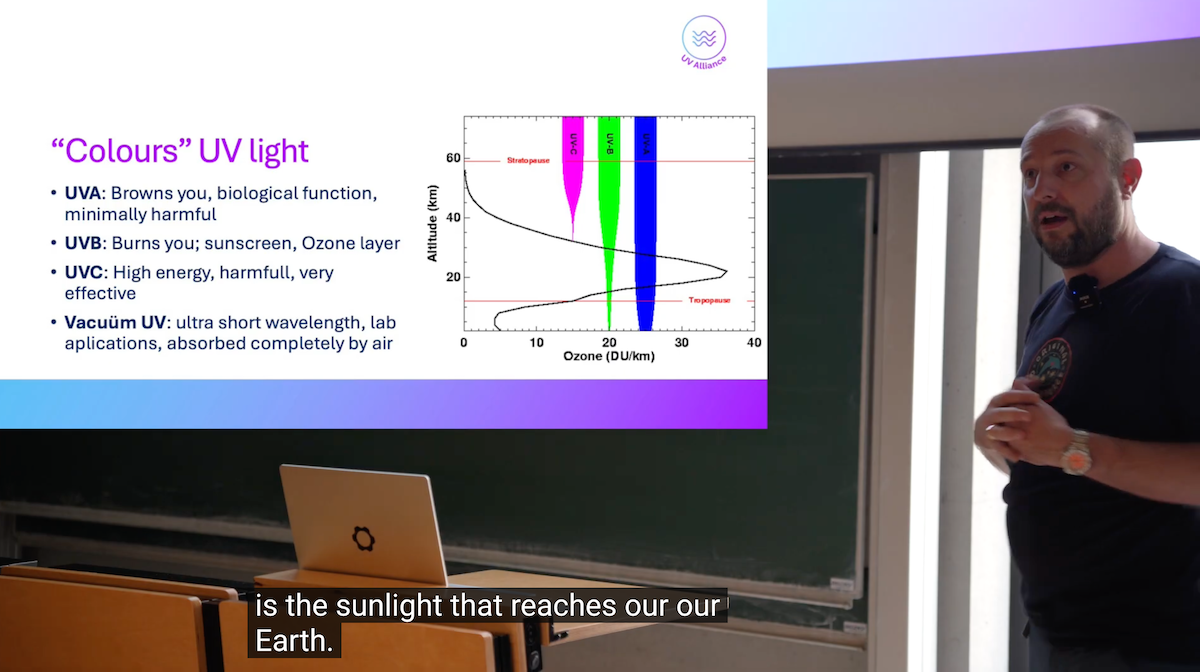
Different UV sources offer different advantages
Low-pressure lamps are highly efficient and mainly produce light around 254 nm. Medium-pressure lamps generate much more power from a compact lamp, but use more electricity. They also produce a broader UV spectrum.
UV-C LEDs are the newest UV source, but their output and electrical efficiency are still limited. Kaspar stressed that sustainability should therefore be assessed across the complete system. A mercury-free light source is not automatically more sustainable if it requires significantly more electricity.
2. UV dose and water quality determine performance
The UV dose is one of the most important parameters in a UV system. It combines light intensity and exposure time. Water flow through the reactor also determines how much UV energy microorganisms actually receive.
Different organisms require different doses. Viruses, algae, fungi and protozoa can respond very differently to UV light. A system must therefore be designed for the organisms it needs to control.
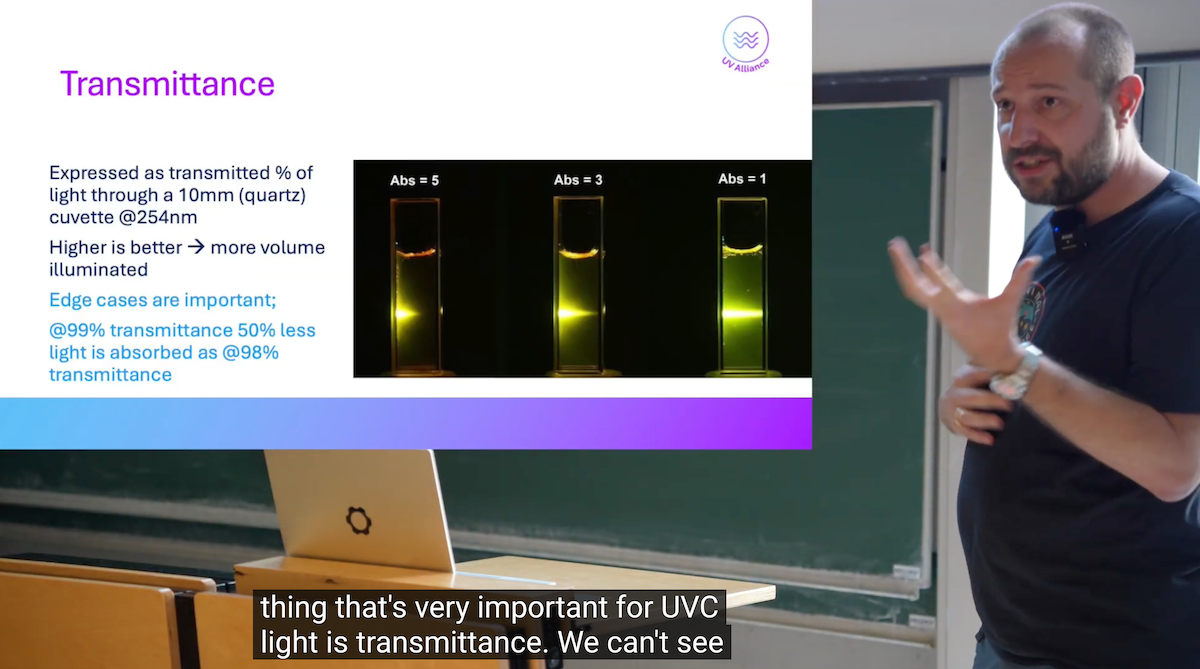
Minimum dose and water quality
Average UV dose tells only part of the story. The minimum dose can be even more important. A small volume of poorly treated water can reduce the performance of the entire system. That is why engineers try to make the minimum dose as close as possible to the average dose.
Water quality adds another challenge. UV Transmittance, or UVT, shows how easily UV light passes through water. Clear-looking water can still contain dissolved organic substances that strongly absorb UV-C. A low UVT means that UV light penetrates less deeply. The reactor must then be designed differently. UVT should also not be confused with turbidity. Turbidity measures particles. UVT measures UV absorption. The two parameters cannot simply replace each other.
3. Good reactor design saves energy
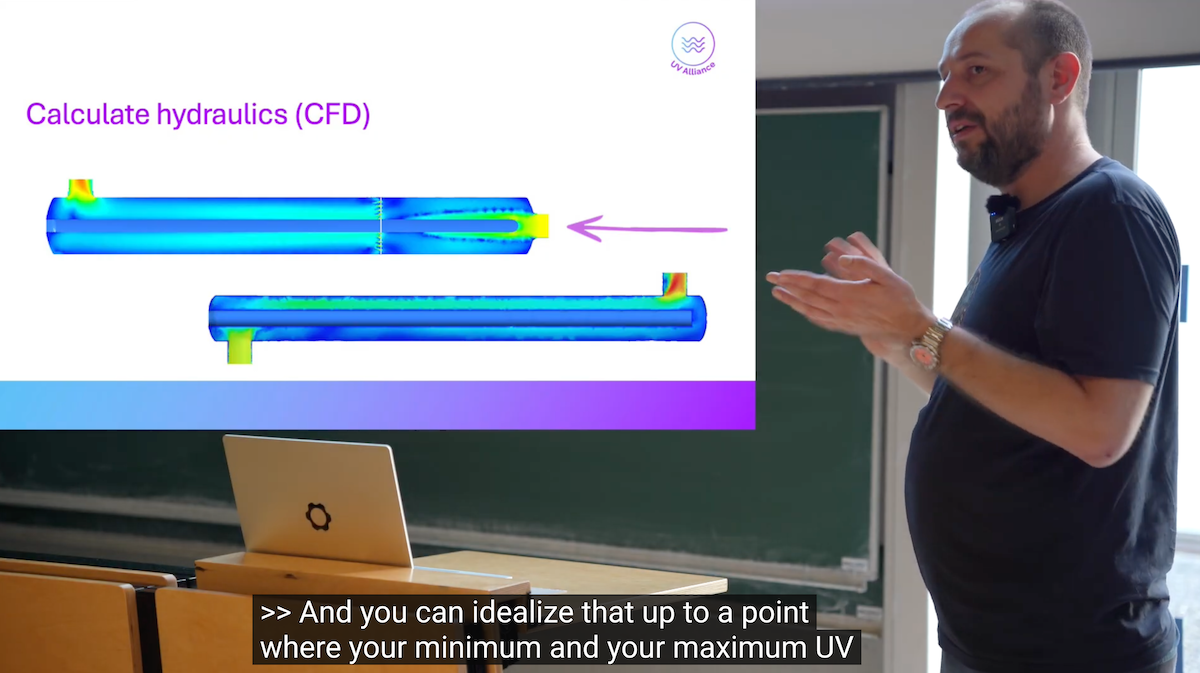
A UV lamp alone does not make an effective UV system. Kaspar illustrated this with a simple example. Placing a UV lamp directly inside a large tank may look effective, but UV-C does not travel far through water. Parts of the water can receive too little UV, while other parts receive far more than necessary.
A controlled reactor gives engineers much more influence over the treatment process. This is where Computational Fluid Dynamics, or CFD, becomes important. CFD models how water moves through a reactor. By controlling the flow close to and further away from the lamp, reactor designers can bring the minimum and maximum UV doses closer together. This improves treatment efficiency and reduces wasted energy.
Validation of UV systems
Modelling water flow is not enough. UV systems used for disinfection must also be validated. Biological validation uses standardised microorganisms to test the real performance of a reactor. Samples are taken before and after UV treatment. Surviving organisms are counted. The results are then linked to the UV sensitivity of the test organism.
Validation also considers real operating conditions. Lamp output declines during its lifetime. Sensors must remain accurate. Water temperature, reactor geometry and lamp position can also influence performance. A validated system therefore proves what it can achieve not only under ideal conditions, but also during actual operation.
4. Removing micropollutants with Advanced Oxidation
UV technology can do more than disinfect water. Modern water sources contain increasing numbers of micropollutants. These can include pharmaceuticals, hormones, pesticides, antibiotics, cosmetics and other persistent substances.
Many of these compounds are designed to remain stable. That is useful during their intended application, but creates a challenge when they enter the environment. Some compounds can be broken down directly by UV light. For many others, more is needed.
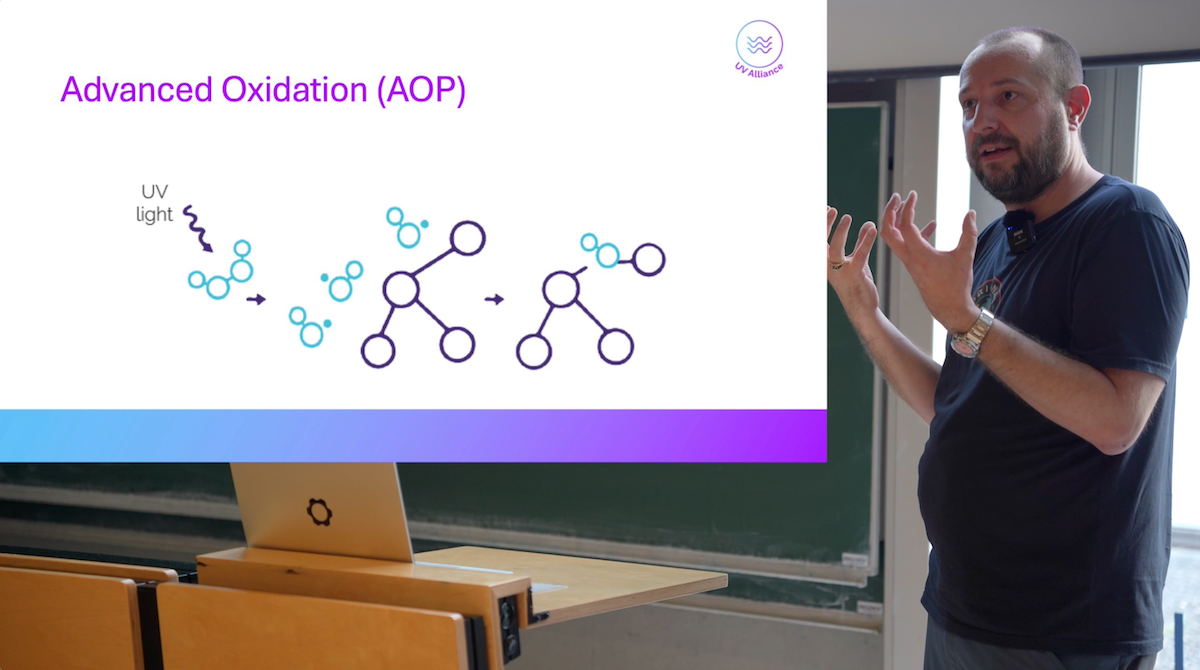
Advanced Oxidation in water treatment
Advanced Oxidation combines UV light with hydrogen peroxide. UV splits the hydrogen peroxide and creates highly reactive hydroxyl radicals. These radicals attack organic micropollutants and break them down into smaller, more biodegradable components or mineralisation products. The high UV dose has another advantage. It simultaneously disinfects the water. This is particularly relevant when addressing antibiotic resistance. Treatment should not only target antibiotic residues. It should also address resistant microorganisms and genetic material that can transfer resistance between bacteria.
5. Sustainable water treatment
A water treatment technology is not sustainable simply because it produces cleaner water. Its energy use, environmental footprint, operating costs and interaction with other treatment processes all matter. Kaspar illustrated this by comparing UV Advanced Oxidation with technologies such as activated carbon and ozonation.
Water quality plays a major role. Treating water with low UV transmittance requires more energy. But pretreatment can change the equation. For example, filtration can improve UV transmittance before the water reaches the UV reactor. This can significantly reduce the energy required for the next treatment step.
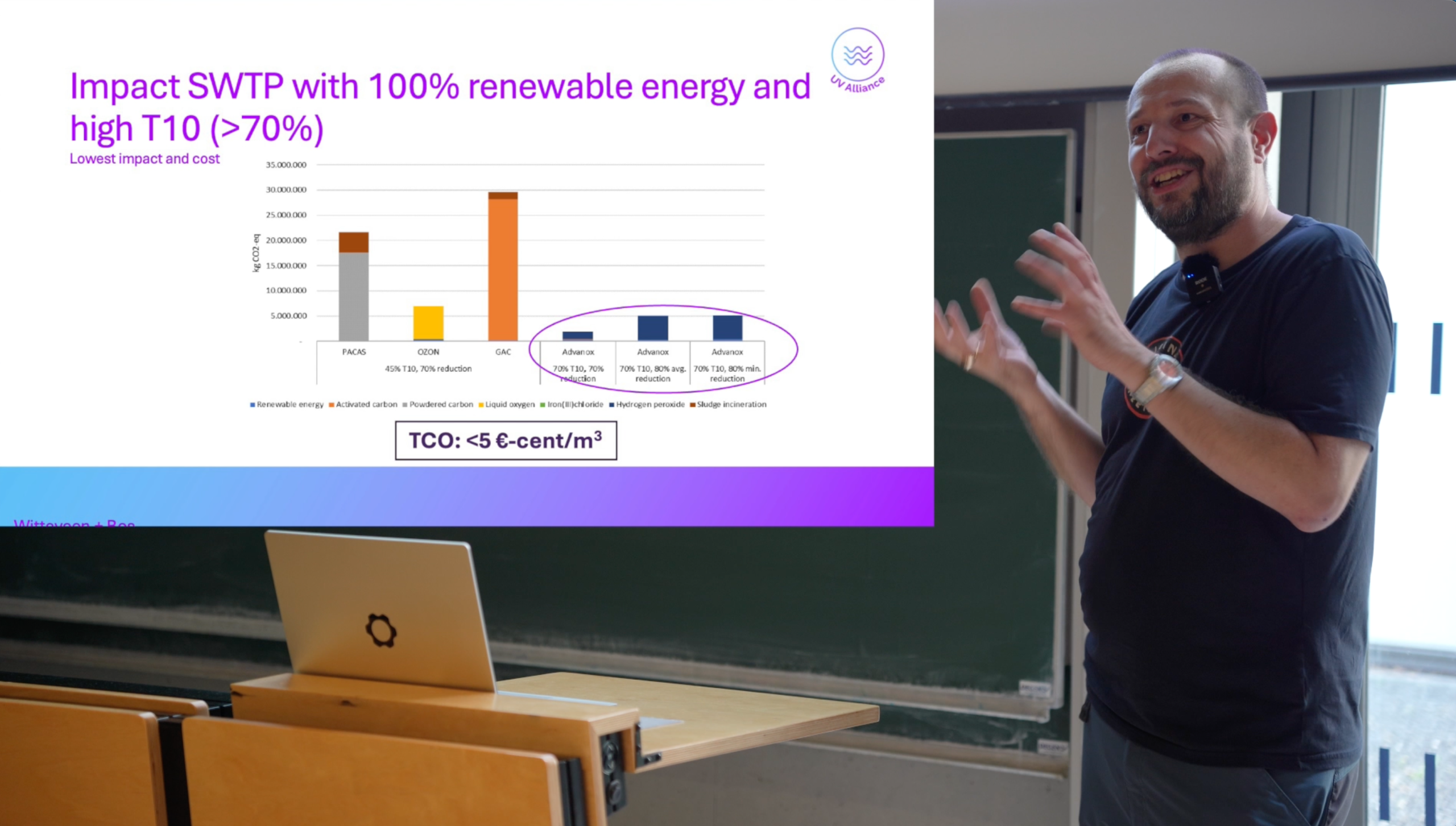
Lifecycle ananlysis and Total Cost of Ownership
The enercy source needs to be taken into account when evaluating environmental impact of water treatment technologies. An electricity-based technology can benefit directly from the transition towards renewable energy. Its lifecycle footprint can therefore change as the electricity mix becomes cleaner.
This is why Life Cycle Assessment is important. It looks beyond one performance parameter and considers the wider environmental impact. Total Cost of Ownership adds another perspective. It includes the investment, replacement parts, energy, chemicals and other operating costs over the full lifetime of the installation.Together, these factors help engineers choose the right technology for each application.
Knowledge is part of sustainable water treatment
This lecture reflects the wider objective of the UV Alliance: making UV knowledge accessible. Water treatment challenges are becoming more complex. No technology works best in every situation. Engineers need to understand how technologies interact and how water quality affects performance.
For the students in Bottrop, the lecture therefore went beyond UV technology itself. It demonstrated how microbiology, chemistry, optics, hydraulics, environmental science and engineering come together in real-world water treatment. That multidisciplinary approach will become increasingly important as water scarcity, micropollutants and energy use place greater pressure on our water systems.
Contact us
Are you also interested in a lecture or presentation by one of our UV experts? Please sent us an email via contact@uv-alliance.com or contact one of our members directly.
Treatment of industrial wastewater
A company in the Netherlands encountered the issue that their on-site wastewater treatment could not remove 1,4-dioxane, resulting in outgoing concentrations exceeding local regulations. The permitted maximum outgoing concentration was <1 mg/L, requiring a removal efficiency of >92% to meet discharge limits.


Reduced invironmental impact
Very effective removal of 1,4-dioxane with advanced oxidation technology.

Energy savings
By optimizing the dosage of UV-C light and hydrogen peroxide, the energy waste of the AOP installation is minimal, consuming 0.70 kWh/m3.
Stricter EU regulations regarding dioxane
Companies in the chemical industry are facing stricter EU regulations regarding dioxane, a common by-product of chemical processes. This is a positive development because dioxane is persistent and toxic, can easily spread in water, and is carcinogenic. 1,4-Dioxane is often found in cosmetic products, formed unintentionally as a by-product in the production process. To prevent dioxane from entering nature and even our groundwater, reliable removal is necessary. This poses a challenge for companies to develop robust water treatment methods that mitigate risks and avoid downtime.

UV Solution:
UV advanced oxidation reactor to purify water from dioxane. It combines UV-C light and (sustainable) hydrogen peroxide, reacting with the contamination and ‘burning’ it in the water, breaking it down into harmless particles.
UV Results:
Removal of 1,4-dioxane from industrial wastewater.
UValue Creation:
- Environmental impact: because AOP is an intensive treatment, the treatment is extremely effective.
- No chemicals: any residual hydrogen peroxide is not a problem for the subsequent wastewater treatment plant, in other applications it can be easily removed with minimal impact on treatment costs.
Case study facts:
Location: The Netherlands
UV system supplier: Van Remmen UV technology
Naturally purified water for Efteling theme park
Efteling requires 400,000 m³ of water annually for attractions, ponds, and irrigation, but groundwater extraction is no longer permitted due to scarcity. A sustainable solution was developed by sourcing an alternative supply from treated wastewater.

UV Solution:
A UV system with five low-pressure lamps treats 75 m³ per hour.
UV Results:
E. coli bacteria were successfully eliminated, making the reuse of the WWTP effluent possible.
UValue Creation:
- Water savings: 400.000 m³ per year
- Environmental impact: Reduced chemical use (chlorine) and less corrosion
Saving valuable water resources
By reusing effluent water at Efteling, 400,000 m³ of valuable water is saved annually. Additionally, this sustainable approach reduces environmental impact by lowering chemical consumption and minimizing corrosion.

Water savings
Instead of pumping 400.000 cubic meters of groundwater, effluent from the WWTP is now being reused.
Reduced environmental impact
The use of a sustainable UV system reduces chemical consumption (chlorine) and minimizes corrosion.
The challenge: groundwater extraction is not allowed
Efteling theme park has an annual water demand of 400,000 cubic meters. This water is used to maintain the levels of water attractions, ponds, and fountains. Additionally, water is needed for irrigating the park’s vegetation and golf course. Due to groundwater scarcity, extraction is no longer permitted in North Brabant. Therefore, Efteling, in collaboration with the province and the Brabantse Delta Water Board, has sought a sustainable water supply solution.

Situation before the UV installation
Since 1997, the Efteling has been purchasing treated domestic wastewater from the Kaatsheuvel wastewater treatment plant (WWTP), as an alternative to pumping up fresh groundwater that used to be treated with chlorine. To improve the water quality of the treated wastewater, a constructed wetland (helophyte filter) was installed. However, due to high phosphate levels—which stimulate algae growth—an additional treatment step was needed. As a result, the effluent was first passed through a sand filter with iron dosing at the WWTP.

Results after installation of the UV system
As a final treatment step, UV disinfection is now used to eliminate unwanted bacteria in the effluent. By treating 75 m³ of effluent per hour at 300 J/m², E. coli bacteria are successfully removed. UV disinfection enables the safe and healthy reuse of WWTP water, achieving a water quality comparable to the EU bathing water standard.

Case study facts:
Organization name: Efteling theme park | WWTP Brabantse Delta Water Board
Location: Kaatsheuvel, the Netherlands
UV system supplier: Van Remmen UV Technology