Germicidal effectiveness of UV sources
Energy efficiency is one of the most important parameters when evaluating UV-C technologies. This article focusses one specific element of UVC efficiency: the wavelength and how the germicidal effectiveness effects the energy efficiency of different UV sources.


Wavelength & germicidal effectiveness
The wavelength of the UV radiation is important because microorganisms respond differently to different parts of the UV-C spectrum. Low-pressure UV lamps emit predominantly at 253.7 nm. UV-C LEDs used for water treatment typically emit between approximately 260 and 280 nm. Medium-pressure lamps produce polychromatic UV light across a broader spectrum, enabling more complex reactions or faster disinfection, especially in compact installations or high-flow environments.
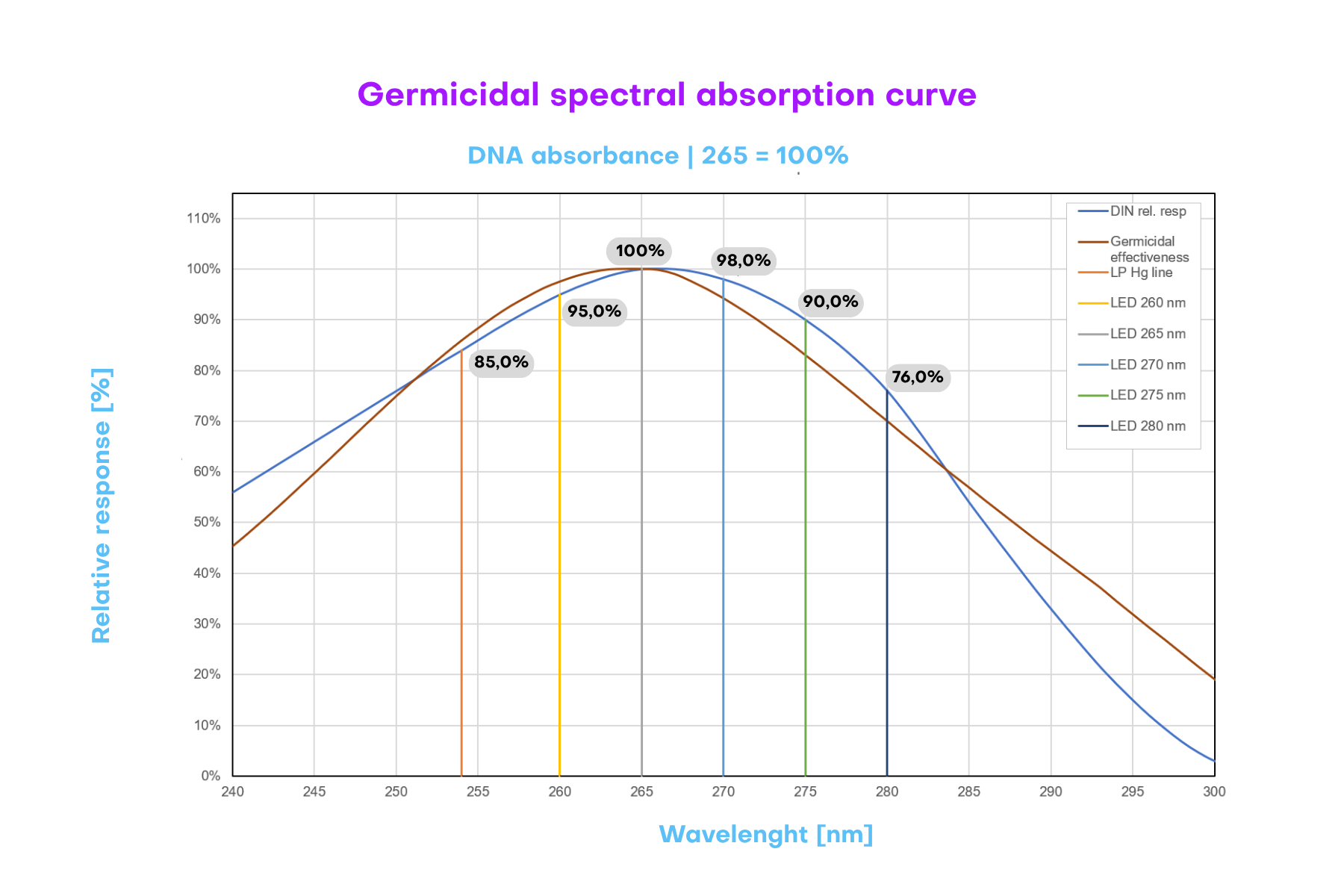
Spectral absorption and germicidal effectiveness explained
Spectral absorption and germicidal effectiveness are two different concepts. While spectral absorption describes how strongly UV radiation is absorbed by DNA and RNA, germicidal effectiveness describes how effectively UV radiation inactivates microorganisms. A higher absorption does not necessarily result in greater germicidal effectiveness. The biological effect also depends on the quantum yield, which describes the probability that an absorbed photon causes a specific photochemical reaction, as well as other biological factors.
Consequently, the DNA absorption spectrum and the germicidal action spectrum are not identical, as shown in the graph.
Spectral absorption and germicidal efficiency of UV-C LEDs
Wavelengths around 265 nm correspond closely to the germicidal action spectrum of many microorganisms. In literature 265nm is seen as the optimum wavelength for DNA/RNA absorption and disinfection. However, in certification, validation and the connected EU frameworks 254nm is still the standard used. European disinfection validation norms (such as DVGW W294 for water or ÖNORM) mandate chemical actinometry or bio dosimetry calibrated specifically to the 254 nm emission line. This is also because of the difference in germicidal efficiency of UV water treatment systems.
Germicidal efficiency
The germicidal efficiency is the ratio of effective germicidal UV output to the electrical power consumed by a UV source. The difference is illustrated in the comparison example below.
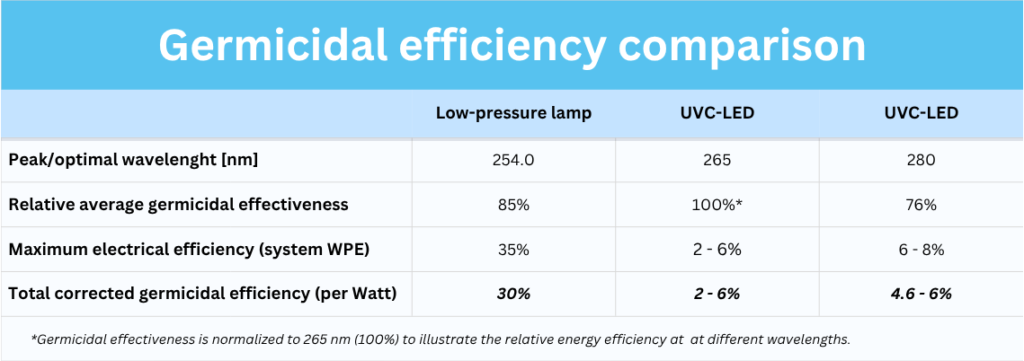
Mathematically, 265 nm delivers a 15% to 20% purely energetic advantage in DNA/RNA disruption compared to an equal dose of 254 nm radiation, based on the germicidal effectiveness. But this is not nearly enough, by a factor 5 to 10, to offset the difference in electrical efficiency of the sources used as available in datasheets now.
Other considerations:
- There are significant differences in micro-organisms and applications, however any form of UV-C disinfection aims to be a full solution for sanitation and not specific for one organism or application.
- Because EU validation protocols look at physical fluence (delivered mJ/cm2at 254 nm), they treat a dose of 254 nm light as the baseline. Any system using 265 nm must over-deliver on raw physical dose according to old tracking sensors, meaning the 15–20% biological benefit is legally invisible under current uncorrected frameworks.
- Producing efficient UV-C LEDs becomes increasingly difficult at shorter wavelengths. LEDs around 270–280 nm therefore currently tend to offer higher electrical efficiency (max 8%) than LEDs operating closer to 265 nm.
Germicidal effectiveness of medium-pressure UV lamps
For applications requiring high UV-C output and irradiance, medium-pressure technology can offer a significant advantage. One of the key differences between medium-pressure UV lamps and UV-C LEDs is the amount of UV-C light (UV intensity) that can be generated from a relatively compact source.
Its high-power density allows substantial UV-C radiant flux to be generated from a relatively small number of lamps, making it particularly well suited to high-flow disinfection applications.
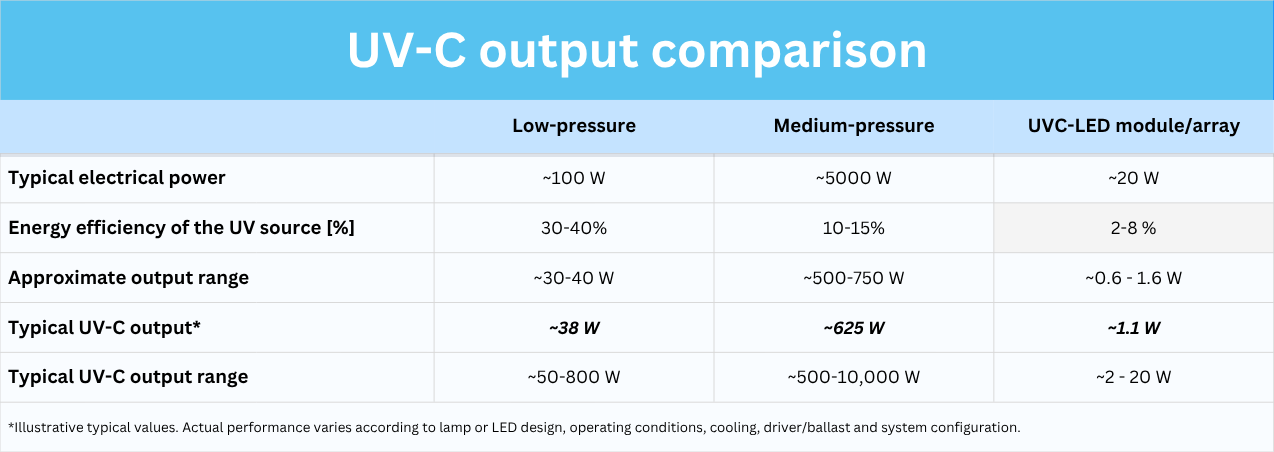
The comparison below illustrates the typical relationship between electrical input, UV-C conversion efficiency and resulting UV-C output across the three technologies.
Comparison example
Other considerations
- As the tables shows, efficiency of the UV source alone does not tell the whole story. The significantly higher electrical power and power density of medium-pressure lamps allow a single lamp to generate hundreds of watts of UV-C output from a relatively compact source.
- The relatively low optical output of individual LEDs means that large numbers of emitters need to be combined into arrays to achieve to achieve a reasonable UV-C output.
- Medium-pressure lamps also produce broad, polychromatic UV emission, covering a wide range of germicidally relevant wavelengths, including the approximately 260–270 nm region where many microorganisms exhibit high UV sensitivity.
Sustainable UV water treatment
When evaluating UV sources, it’s important to compare complete systems under equivalent operating condition and for the actual application in which it operates. Germicidal effectiveness and efficiency are important. However, a meaningful comparison cannot be based on a single parameter. The efficiency of a UV system depends strongly on the application and required uptime, the required UV dose, system size, treatment capacity and, importantly, how the system is operated (intermittent or continuously).
Related articles:

Supporting Sources
- LuxaLight Engineering & Technical Data Documentation
- Writeout: This technical brief details the mathematical correction factors required when calculating disinfection doses between mercury vapor lamps (254 nm) and UV-C LEDs (265 nm). It confirms that the germicidal weighting at 265 nm is designated as a baseline of 1.00 (100%), whereas 253.7 nm tracks at a weighting factor of approximately 0.85 (85%).
- Direct Link: UV-C LED Disinfection Systems (255 & 265 nm)
- The Impact of Time and Temperature of Operation on the Characteristics of High-Power UVC LEDs and Their Disinfection Efficiency
- Writeout: This peer-reviewed publication maps the official, modern germicidal effectiveness curves standardized by the Illuminating Engineering Society of North America (IESNA) and the German Institute for Standardization (DIN). The paper demonstrates that both standard bodies place the maximum inactivation efficiency (equal to 1.0) right at the 265 nm wavelength, while noting that moving down to 254 nm drops the baseline action spectrum curve by 15% to 20%.
- Direct Link: (PDF) The Impact of Time and Temperature of Operation on the Characteristics of High-Power UVC LEDs and Their Disinfection Efficiency
- The Ultraviolet Germicidal Irradiation Handbook (W. Kowalski)
- Writeout: This text is widely considered the ultimate engineering reference for designing building, air, and fluid UVC disinfection systems. It focuses heavily on mapping exact relative efficiency metrics between competing light wavelengths. In Chapter 2 and 3, the textbook details the origin and explicit mathematical curves of nucleic acid disruption. Kowalski records that the absolute peak wavelength for inactivating pathogens like E. coli sits at 265 nm. The handbook explicitly reports that the 265 nm wavelength is approximately 15% more effective at inducing lethal structural DNA damage than the standard low-pressure UVC peak output of 254 nm.
- Direct Link: (PDF) Ultraviolet Germicidal Irradiation Handbook
-
CIE 155:2003 – Ultraviolet Air Disinfection
- Writeout: According to CIE 155:2003, the germicidal effectiveness of UV radiation depends on its wavelength. Based on the DIN germicidal action spectrum presented in Table 2, UV radiation at 280 nm has approximately 76% relative germicidal effectiveness when normalized to 265 nm (100%). CIE 155:2003 specifically addresses ultraviolet air disinfection. It is important to note that the UV sensitivity of certain microorganisms and viruses may differ slightly between air and water environments. Therefore, the relative germicidal effectiveness may vary depending on the microorganism and the application.
- Direct link: (PDF) International Commission on Illumination (CIE), Reference: Pages 13–14, Table 2.