UV-C lamps vs. UV-C LEDs: cost comparison
UV-C LEDs are sometimes considered as an alternative to conventional UV-C lamps. But how do the two technologies compare from a cost perspective? In this article, we look specifically at two important factors: energy consumption and replacement costs. We compare the energy required to generate UV-C output and explore the costs associated with replacing UV-C lamps versus UV-C LEDs.

System performance comparison
A direct cost comparison between conventional UV-C lamps and UV-C LEDs is challenging. In practice, these technologies are generally not interchangeable on a one-to-one basis. Replacing UV lamps with LEDs would typically require a substantial redesign or retrofit of the complete UV system, including its optical, electrical and thermal design. For an objective comparison, a full lifecycle analysis at system and application level would therefore be more appropriate. However, to provide an indication of the differences in replacement costs, this article uses a simplified scenario in which UV lamps and UV-C LEDs are assumed to be interchangeable UV-C sources.
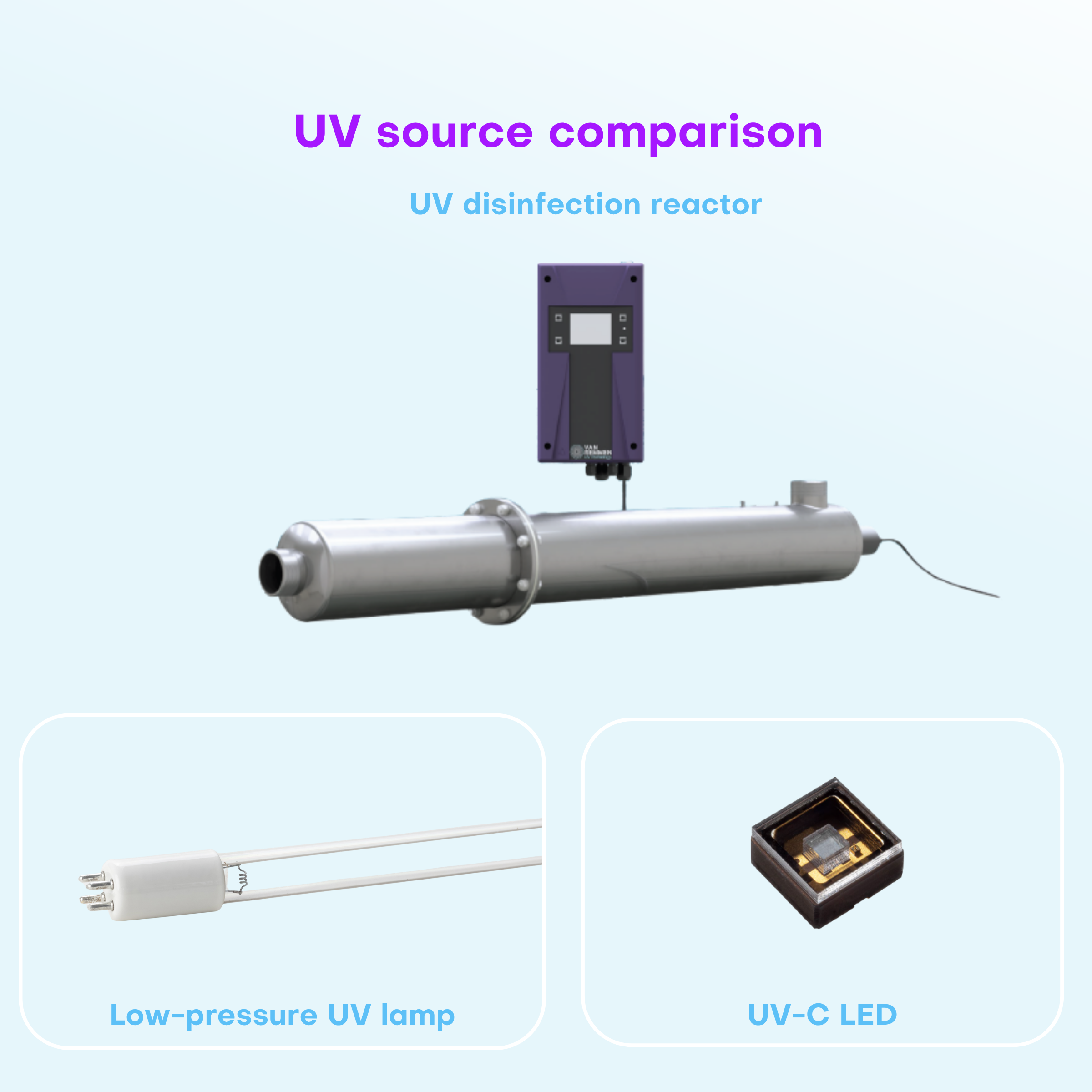
Comparing performance of UV sources
This represents an idealised scenario in which both technologies are assumed to be fully interchangeable, with LEDs positioned like a conventional lamp, surrounded by water, passively cooled, and providing optimal UV-C light distribution. In practice, however, the optimal design principles for low-pressure lamp systems and LED-based systems differ substantially. Low-pressure lamps and UV-C LEDs require fundamentally different reactor designs, and achieving uniform dose distribution with a large number of individual LED sources introduces additional optical, thermal and electrical design challenges.
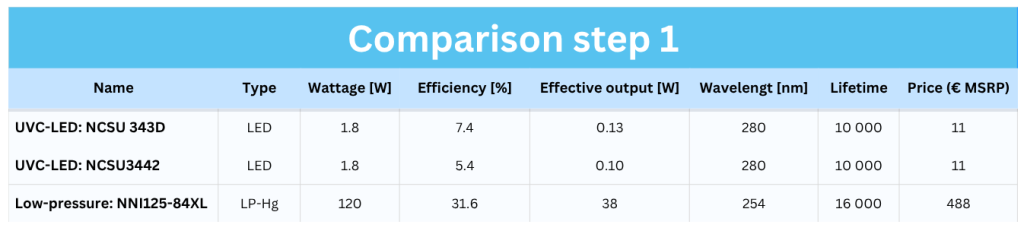
Replacing UV low-pressure lamps by UV-C LED
This study presents a direct engineering comparison in which a single low-pressure UV-C lamp in the V160 system is fully replaced by UV-C LEDs. As an illustrative case, the comparison focuses solely on quantitative metrics, deliberately excluding operational considerations such as availability, form factor, overall system efficiency, and wavelength differences.
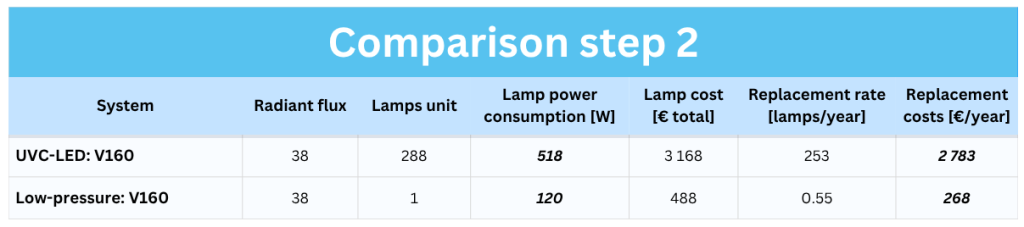
Replacement costs
As can be seen directly replacing a low-pressure lamp for a state-of-the-art UVC-LED will result in:
- A lamp purchase cost increase of 649%
- A more than 10 times lamp replacement cost increase
- A power consumption increase of 432%
The increase in energy costs is caused by the difference in wall-plug efficiency of UVC-LEDs: 2-8% compared to 30-40% for low-pressure lamps. Energy efficiency is one of the most important parameters when comparing UV-C technologies. However, a meaningful comparison cannot be based on a single parameter, such as UV source.
Reactor design and application matter
Reactor design has a significant impact on the overall energy performance of a UV system. The positioning of the UV sources, hydraulics, UV transmittance, optical losses and dose distribution all determine how effectively the generated UV-C light is used. A well-designed reactor can therefore reduce the amount of UV-C output required to achieve the target dose.
The application and operating profile are equally important. UV-C LEDs can be switched on and off instantly, which can reduce energy consumption in intermittent, low-duty-cycle applications. But this advantage becomes much less relevant in applications where a continuous UV disinfection barrier is required. For this reason, energy performance should be compared at system and application level, under equivalent operating conditions, rather than on source efficiency alone.