Lecture: from theory to real-world application
Clean and safe water cannot be taken for granted. At Ruhr West University in Bottrop, Kaspar Groot Kormelinck introduced students to the possibilities of UV technology in modern water treatment. He showed how UV-C can disinfect water, remove micropollutants and reduce environmental impact. But he also made one thing clear: effective UV treatment requires much more than a powerful lamp. Water quality, hydraulics, reactor design, validation and energy use all determine the final result.

1. How UV-C technology works
UV-C is a proven technology for water disinfection. Its short wavelength contains a high amount of energy. At around 254 nanometres, UV-C is strongly absorbed by DNA.
This damages the DNA of microorganisms. Bacteria and other pathogens can no longer reproduce effectively. UV disinfection has been used for more than a century. It adds no disinfecting chemicals to the water. Kaspar also explained that UV disinfection can be highly energy-efficient compared with thermal disinfection methods.
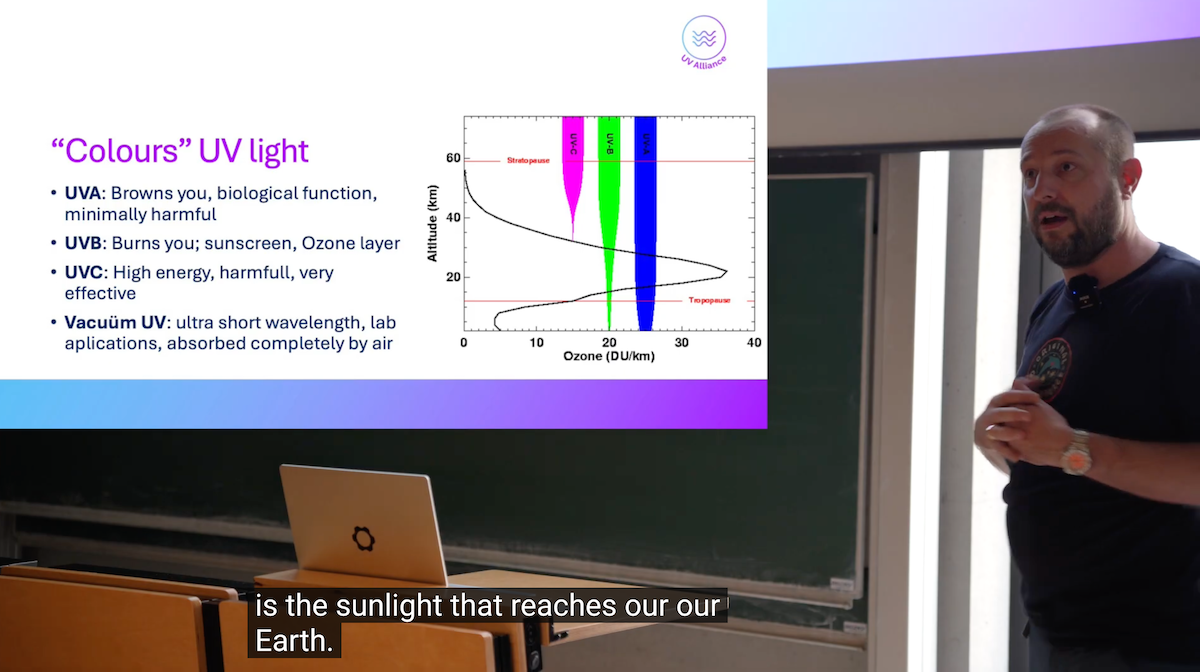
Different UV sources offer different advantages
Low-pressure lamps are highly efficient and mainly produce light around 254 nm. Medium-pressure lamps generate much more power from a compact lamp, but use more electricity. They also produce a broader UV spectrum.
UV-C LEDs are the newest UV source, but their output and electrical efficiency are still limited. Kaspar stressed that sustainability should therefore be assessed across the complete system. A mercury-free light source is not automatically more sustainable if it requires significantly more electricity.
2. UV dose and water quality determine performance
The UV dose is one of the most important parameters in a UV system. It combines light intensity and exposure time. Water flow through the reactor also determines how much UV energy microorganisms actually receive.
Different organisms require different doses. Viruses, algae, fungi and protozoa can respond very differently to UV light. A system must therefore be designed for the organisms it needs to control.
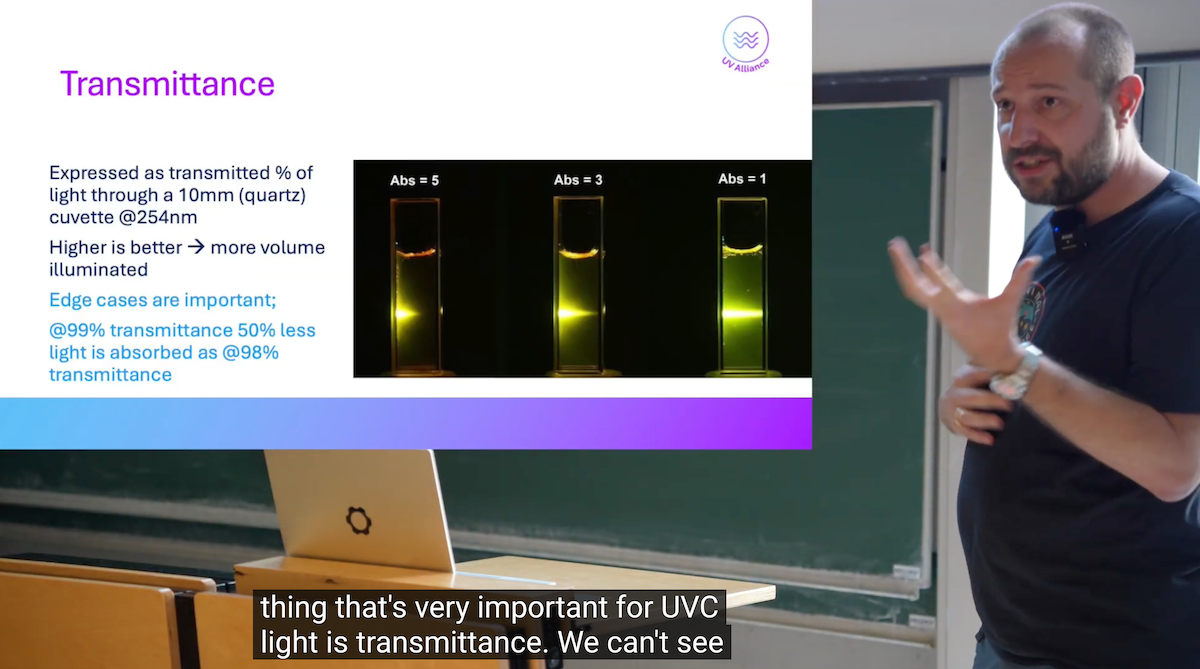
Minimum dose and water quality
Average UV dose tells only part of the story. The minimum dose can be even more important. A small volume of poorly treated water can reduce the performance of the entire system. That is why engineers try to make the minimum dose as close as possible to the average dose.
Water quality adds another challenge. UV Transmittance, or UVT, shows how easily UV light passes through water. Clear-looking water can still contain dissolved organic substances that strongly absorb UV-C. A low UVT means that UV light penetrates less deeply. The reactor must then be designed differently. UVT should also not be confused with turbidity. Turbidity measures particles. UVT measures UV absorption. The two parameters cannot simply replace each other.
3. Good reactor design saves energy
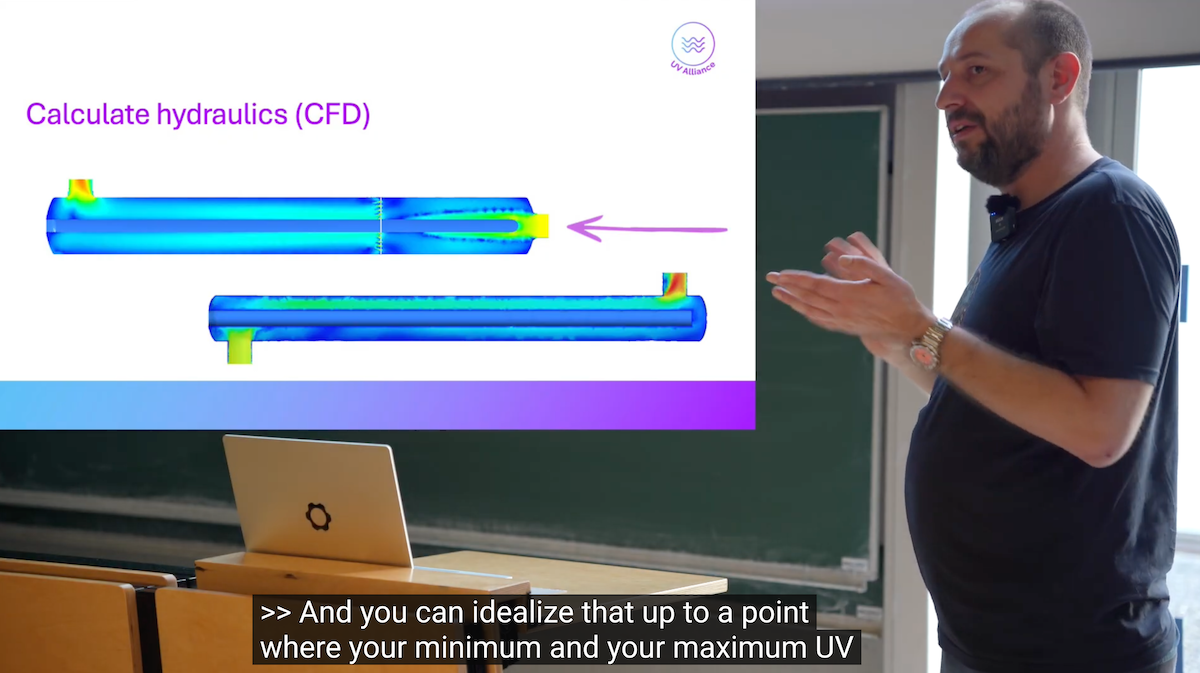
A UV lamp alone does not make an effective UV system. Kaspar illustrated this with a simple example. Placing a UV lamp directly inside a large tank may look effective, but UV-C does not travel far through water. Parts of the water can receive too little UV, while other parts receive far more than necessary.
A controlled reactor gives engineers much more influence over the treatment process. This is where Computational Fluid Dynamics, or CFD, becomes important. CFD models how water moves through a reactor. By controlling the flow close to and further away from the lamp, reactor designers can bring the minimum and maximum UV doses closer together. This improves treatment efficiency and reduces wasted energy.
Validation of UV systems
Modelling water flow is not enough. UV systems used for disinfection must also be validated. Biological validation uses standardised microorganisms to test the real performance of a reactor. Samples are taken before and after UV treatment. Surviving organisms are counted. The results are then linked to the UV sensitivity of the test organism.
Validation also considers real operating conditions. Lamp output declines during its lifetime. Sensors must remain accurate. Water temperature, reactor geometry and lamp position can also influence performance. A validated system therefore proves what it can achieve not only under ideal conditions, but also during actual operation.
4. Removing micropollutants with Advanced Oxidation
UV technology can do more than disinfect water. Modern water sources contain increasing numbers of micropollutants. These can include pharmaceuticals, hormones, pesticides, antibiotics, cosmetics and other persistent substances.
Many of these compounds are designed to remain stable. That is useful during their intended application, but creates a challenge when they enter the environment. Some compounds can be broken down directly by UV light. For many others, more is needed.
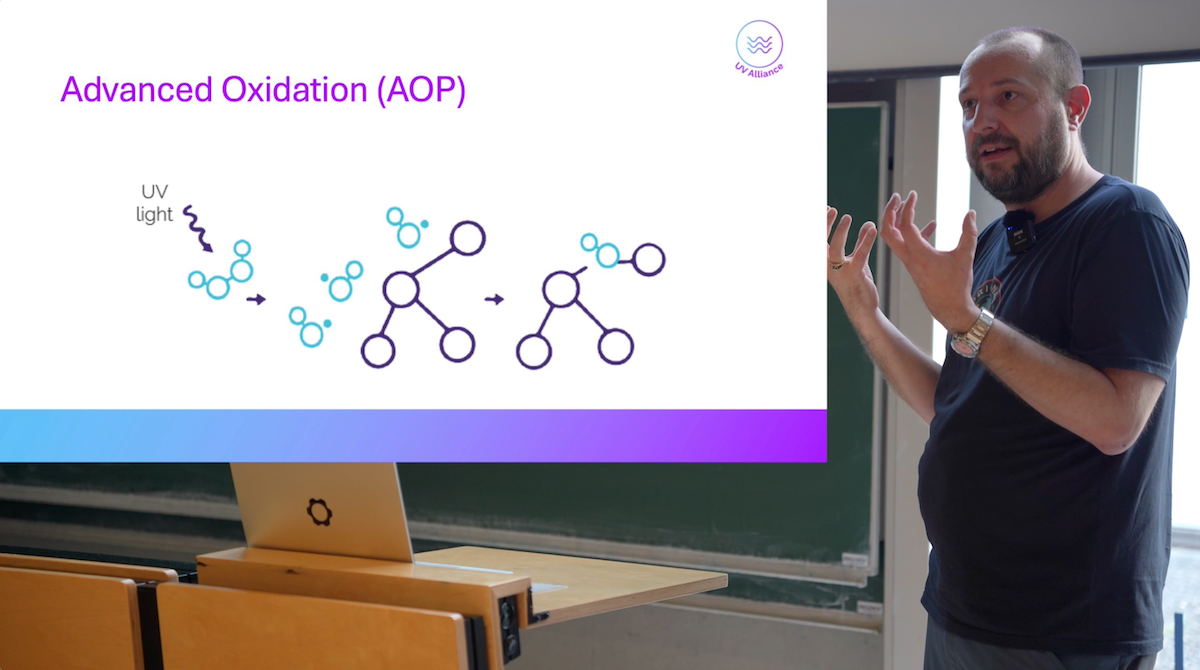
Advanced Oxidation in water treatment
Advanced Oxidation combines UV light with hydrogen peroxide. UV splits the hydrogen peroxide and creates highly reactive hydroxyl radicals. These radicals attack organic micropollutants and break them down into smaller, more biodegradable components or mineralisation products. The high UV dose has another advantage. It simultaneously disinfects the water. This is particularly relevant when addressing antibiotic resistance. Treatment should not only target antibiotic residues. It should also address resistant microorganisms and genetic material that can transfer resistance between bacteria.
5. Sustainable water treatment
A water treatment technology is not sustainable simply because it produces cleaner water. Its energy use, environmental footprint, operating costs and interaction with other treatment processes all matter. Kaspar illustrated this by comparing UV Advanced Oxidation with technologies such as activated carbon and ozonation.
Water quality plays a major role. Treating water with low UV transmittance requires more energy. But pretreatment can change the equation. For example, filtration can improve UV transmittance before the water reaches the UV reactor. This can significantly reduce the energy required for the next treatment step.
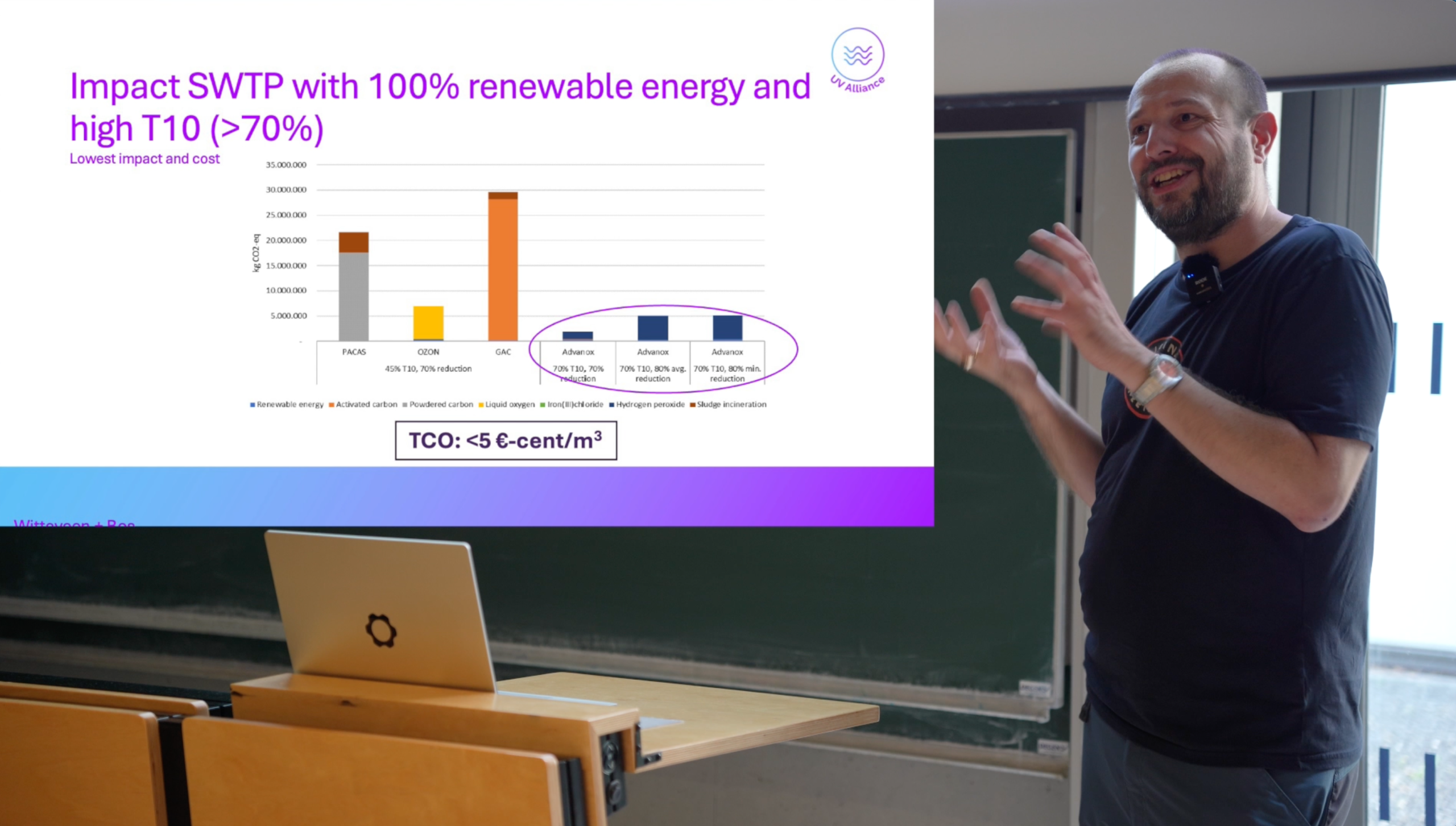
Lifecycle ananlysis and Total Cost of Ownership
The enercy source needs to be taken into account when evaluating environmental impact of water treatment technologies. An electricity-based technology can benefit directly from the transition towards renewable energy. Its lifecycle footprint can therefore change as the electricity mix becomes cleaner.
This is why Life Cycle Assessment is important. It looks beyond one performance parameter and considers the wider environmental impact. Total Cost of Ownership adds another perspective. It includes the investment, replacement parts, energy, chemicals and other operating costs over the full lifetime of the installation.Together, these factors help engineers choose the right technology for each application.
Knowledge is part of sustainable water treatment
This lecture reflects the wider objective of the UV Alliance: making UV knowledge accessible. Water treatment challenges are becoming more complex. No technology works best in every situation. Engineers need to understand how technologies interact and how water quality affects performance.
For the students in Bottrop, the lecture therefore went beyond UV technology itself. It demonstrated how microbiology, chemistry, optics, hydraulics, environmental science and engineering come together in real-world water treatment. That multidisciplinary approach will become increasingly important as water scarcity, micropollutants and energy use place greater pressure on our water systems.

Contact us
Are you also interested in a lecture or presentation by one of our UV experts? Please sent us an email via contact@uv-alliance.com or contact one of our members directly.